AI customer support rarely fails because of the tool. It fails on a decision never taken before switching it on: which inquiries go to the assistant, and which stay with a human? Leave that to improvisation and you end with an apology: a price the assistant invented, or a date it promised.
Which inquiries go to the assistant, and which need a human?
An assistant fits the repeated question with one fixed answer: opening hours, branches, service availability, the steps to sign up, policy terms such as delivery, warranty and returns, and order tracking. Your team already knows these answers; repeating them consumes its day.
It does not fit a complaint, a price negotiation, a request for an exception to policy, a conversation that has turned emotional, or anything that ends in a date or a commitment. Vendor documentation for customer service platforms argues that human agents must sit inside the workflow to step in when needed, and that interactions needing intervention, partial answers or repeat contact should not count as resolved.
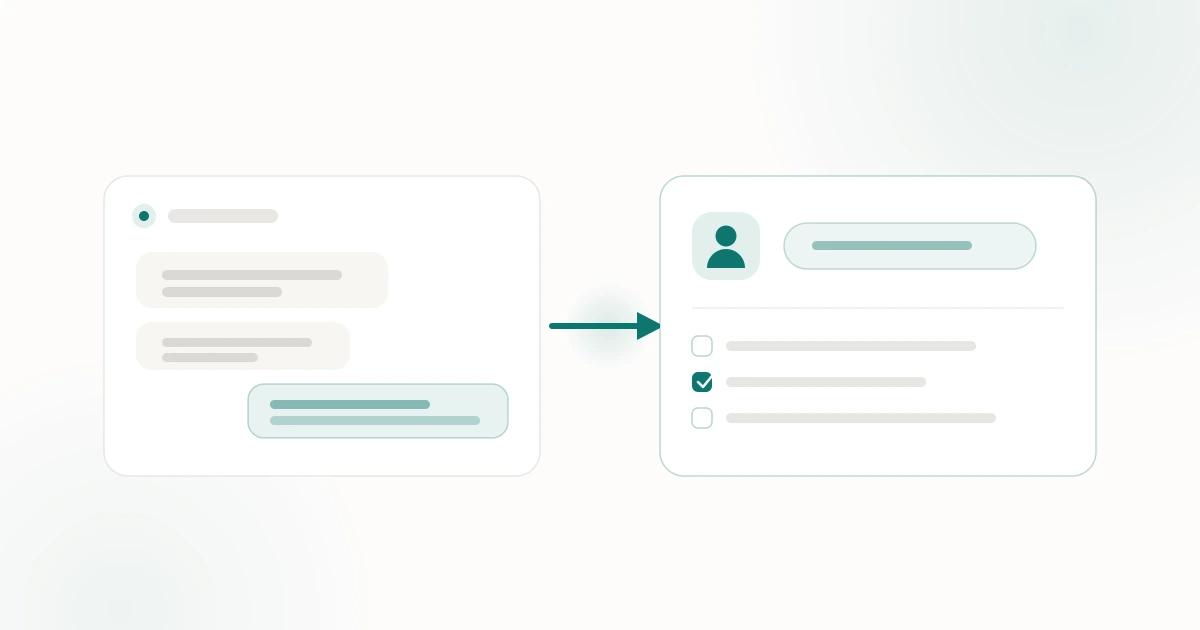
Platform documentation for agent-building tools describes two handoff paths: explicit, when the customer asks for a person, and implicit, when the assistant cannot tell what the request is about. Both pass the conversation context to the human.
What the assistant must know before launch
An assistant answers from the sources you connect it to, not from its own intelligence: your service list, prices from a single official list, working hours and policies. Vendor documentation calls these knowledge sources and offers a setting to block ungrounded answers: with it off, the assistant replies only when it can attach a citation to the source, otherwise the reply is blocked and the fallback message takes over. The documentation notes this setting does not guarantee the model ignores its general knowledge.
More importantly, the documentation warns that the system does not run an accuracy check, so inaccurate information in a source can be shown to users. The ceiling on quality is your own material: an out-of-date price gives you an assistant that is confident, fluent and wrong.
Where responsibility ends: no invented price, no promised date
Write these boundaries into one file for whoever configures the assistant: never state a price outside the approved price list, never promise a delivery date, never give financial or legal advice, and never confirm stock without reading your system. Anything beyond that gets one fixed sentence: I will log your request and hand you to an agent.
The same applies to what goes in: never paste into an external tool an ID number, a document image, card details, health information, a price list, or a password. Policies differ. One provider states that API data is not used to train models by default unless the customer opts in, but abuse-monitoring logs may contain content and are kept by default for up to thirty days; exclusions need prior approval. Another states that inputs and outputs are not used to train foundation models without your permission, though abuse monitoring may still sample content for review.
Read the provider policy before pasting any file; if it is not clear, do not paste it. Keep two questions apart: what you keep, and what the provider keeps.
How do you measure the result?
The easiest number to fool you is the share of conversations never handed to an agent. Vendor documentation warns that some platforms count an abandoned or incomplete conversation as resolved, which makes performance look better than it is, and that a real outcome beats a finished chat.
Measure what you can follow by hand: how many conversations ended without a handoff, how many had the customer return later, and how many questions repeated because the assistant did not understand them. The most useful report is the list of blocked questions where the fallback took over: those are the gaps in your material.
What this means in practice for a company or shop in Libya
Most inquiries here arrive through WhatsApp and by phone, the team is small, and the owner is often the one replying. The first gain is not automation but order: once your repeated questions sit in one file with approved answers, you have an FAQ page and a training reference; writing your delivery and returns policy in final form ends an argument that today repeats verbally.
The second half is honest escalation. In a market built on personal relationships, the problem is not an assistant answering a simple question but an assistant promising a date nobody on the team knows. One that knows when to say I will hand you over protects trust that has not been built yet. The test stays practical: did repeated questions stop reaching your team, and did complaints stay with humans?
Start in this order: collect your repeated questions from real conversations and write an approved answer for each; decide who receives the unanswerable ones; write the prohibitions above with the handoff sentence beyond them; then run the assistant on the narrowest scope for a set period and review it regularly. The services page at /services covers conversation and agent solutions; /contact is the direct channel.
None of this requires replacing all your tools: organise the knowledge, write the boundaries, then open the assistant to the narrowest scope.
Sources
- Microsoft Learn — Hand off to a live agent (Copilot Studio): the two handoff paths (explicit when the customer asks for an agent, implicit when the assistant cannot understand), and passing the conversation context to the agent
- Microsoft Learn — Knowledge sources summary (Copilot Studio): the knowledge sources the assistant answers from, and the setting that blocks ungrounded answers (the reply is blocked when the assistant retrieves no source)
- Microsoft Learn — FAQ for generative answers (Copilot Studio): the system does not run an accuracy check on content, so an error in the source can reach the user
- OpenAI — Data controls: API data is not used to train models by default without consent, abuse-monitoring logs may contain content and are kept for up to thirty days, and exclusions require prior approval
- Microsoft Learn — Data, privacy, and security for Foundry Models sold by Azure: inputs and outputs are not used to train the foundation models without your permission, and a sample may be selected for automated review and, when needed, human reviewers
- Zendesk — What is AI resolution rate and how to measure it: some platforms count an abandoned or incomplete conversation as resolved, and an agent must sit inside the workflow to step in when needed
This article was produced with the help of AI tools and reviewed by a human before publication.